
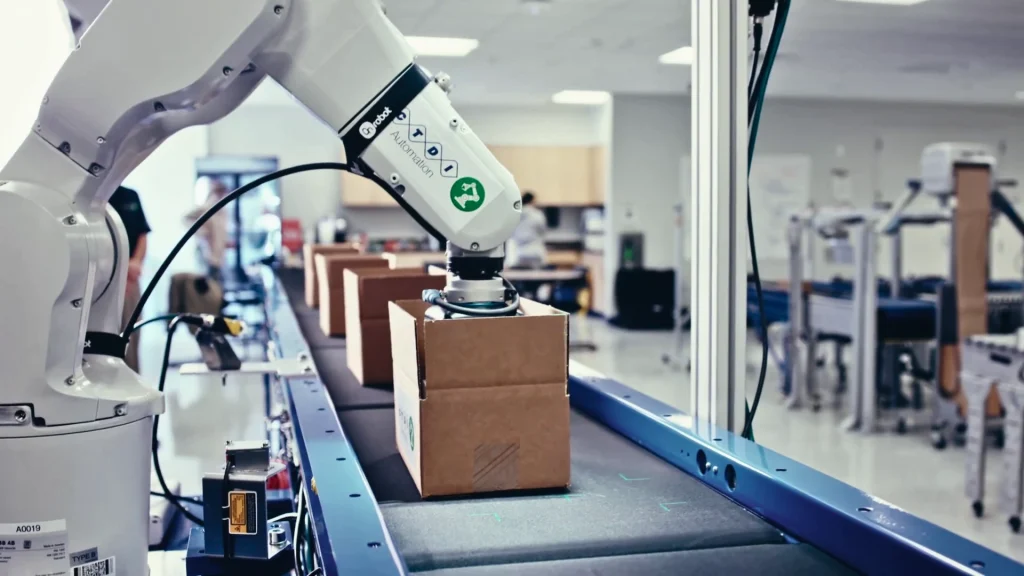


Humanoid Robotic Automation
In Development: Wireless Control Cards for Humanoid Robot Integration
We’re building the interface layer between humanoid robots and the conveyor infrastructure they’ll work alongside — a control card that lets a humanoid robot communicate wirelessly with your conveyor zones and existing logistics data systems, without the hardwired signal integration legacy systems require.
Why This Matters Now
Distribution centers are running into the same wall from two directions at once: workforce availability hasn’t kept pace with order volume, and the conveyor infrastructure built for human pickers wasn’t designed to hand off work to a robot. Humanoid robots are a genuinely new category of picker — but only if the conveyor can actually talk to them in real time. That’s the specific gap we’re building this control card to close.
Technical Authority
A humanoid robot working a conveyor line needs to know the same things a human picker knows instinctively — which zone has product, when it’s safe to reach in, what’s coming next — but a robot needs that information as structured data, delivered fast enough to not become the bottleneck. That’s a harder problem than it sounds:
- No common communication standard — by design, we’re not betting on one. Humanoid robot platforms don’t share a single protocol today, and the market hasn’t consolidated around one yet. Rather than build for a single manufacturer and risk obsolescence the moment a facility runs a different platform, we’re developing the control card to work across humanoid robot platforms generally — a deliberate choice, not a gap.
- Latency matters more than it does for humans. A human picker adapts on the fly. A robot executing a pick cycle needs zone-status data fast enough that wireless communication doesn’t become the slowest part of the cycle.
- Retrofit compatibility. [CONFIRM: is this card designed to interface with existing installed 24VDC MDR zone controllers as an upgrade path, or only with new builds? This matters a lot to the “retrofit, not replace” positioning on the rest of the site — if it works with what customers already have installed, that’s a significant claim worth making explicitly.]
- Safety at the human-robot boundary. Any line where a robot and human may still work in proximity needs the same kind of real-time, standards-based safety response — instant stop, controlled zones — that we’ve built into 24VDC MDR itself.
Proof of Concept: The Three-Generation Tunnel
We don’t think a claim like this belongs on a page without a way to prove it. So we’re building one.
We’ve broken ground on a large-scale pick-to-light tunnel built specifically to run three generations of conveyor technology side by side, in the same building, under the same conditions:
A 460VAC conveyor segment with a human picker
the baseline most distribution centers are still running today
A retrofitted 24VDC MDR conveyor segment with a human picker
what modernization looks like right now
A 24VDC MDR conveyor segment integrated with a humanoid robot picker
what we’re building toward
Running all three side by side means we’re not asking anyone to take our word for what this technology can do. We’ll be able to show it, generation by generation, in one facility.
Why Facility Functions
This isn’t a new company chasing a trend. We’ve engineered 460VAC systems since the beginning, built our modernization business retrofitting them to 24VDC MDR, and now we’re building the layer that connects that same infrastructure to humanoid robotics — one continuous line of engineering, not three separate bets.
Why This Matters Now
Distribution centers are running into the same wall from two directions at once: workforce availability hasn’t kept pace with order volume, and the conveyor infrastructure built for human pickers wasn’t designed to hand off work to a robot. Humanoid robots are a genuinely new category of picker — but only if the conveyor can actually talk to them in real time. That’s the specific gap we’re building this control card to close.